 Illustration
What Listing on Meta Shops Hands Meta, and How to List Within It
By Desert Cities News · October 30, 2026Marketing · Commentary · Meta · Seller Agreement · Licensing
Drafted with AI from cited sources and edited by Desert Cities News. How we use AI
Today, we cover:
- The Seller Agreement, the short version. Selling through Meta Shops licenses your listings, and the pages behind them, to Meta permanently.
- Facebook's own terms, for contrast. Their license ends when you delete your content. The seller license is written differently.
- The October 30 update. Meta's updated Commercial Terms name more purposes for the license and a wider set of places to collect from.
What the Seller Agreement takes
When you sell through Meta's commerce features, you agree to the Seller Agreement, last updated May 26, 2026. Its license clause gives Meta a non-exclusive, perpetual, irrevocable, transferable, sub-licensable, royalty-free, worldwide license to host, use, distribute, modify, copy, publicly display, translate and create derivative works from your product listings.
The license is not limited to the listing. It also covers "any other content, data, or information" you share in connection with the commerce features, or that Meta accesses. You keep ownership, and because the license is non-exclusive you can license the same photograph elsewhere. But you also warrant that you hold every right you are licensing, and the agreement makes you solely responsible for what you upload.
Meta does not wait for you to send everything. If you give it a URL, as a product catalog's links do, the agreement lets Meta and anyone acting for it access, index, cache, analyze and crawl that URL and the content available through it, and, depending on your account settings, pull updates from it periodically. The page a product link opens is therefore part of what you license, along with whatever sits on it.
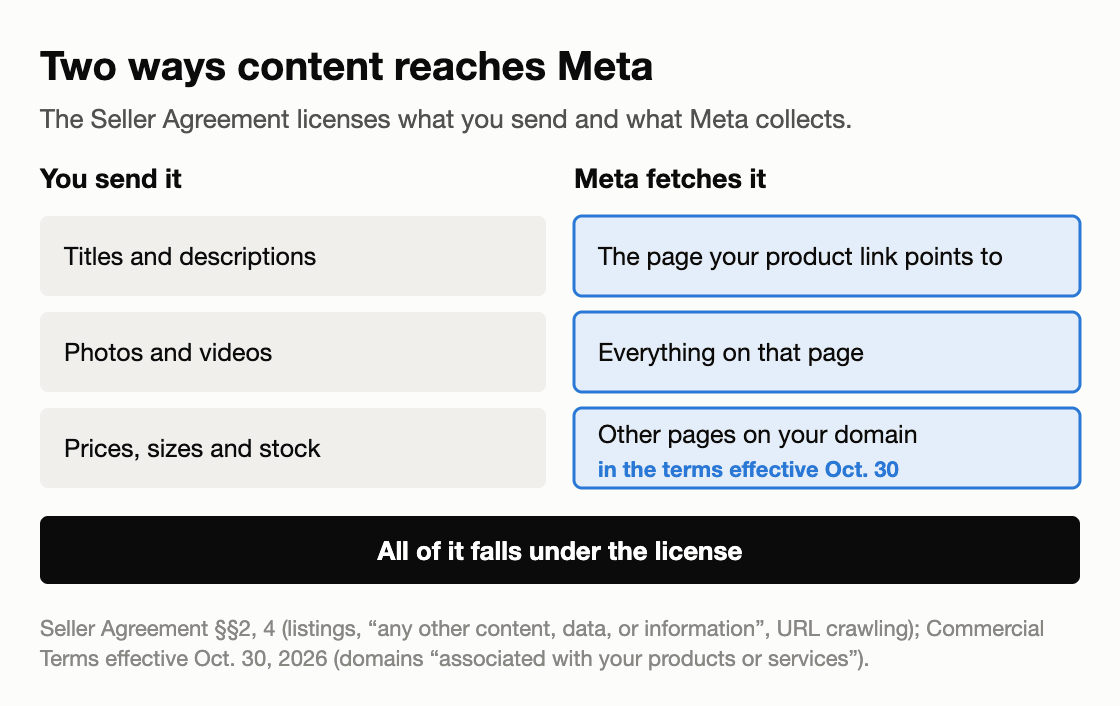
The costs fall on the seller too. You indemnify Meta against claims arising from your products and from any breach of the agreement. Meta's own liability to you is capped, in its Commercial Terms, at the greater of $100 or what you paid it in the previous twelve months.
Where it differs from Facebook's terms
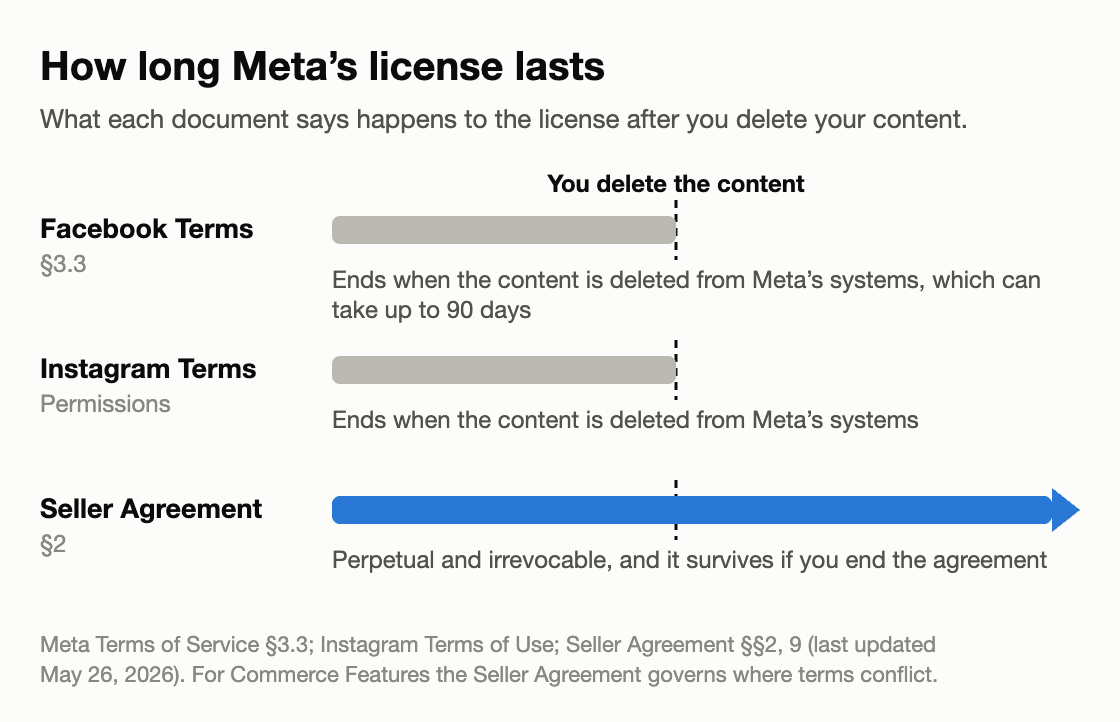
Facebook's general Terms of Service take a narrower license. It is non-exclusive, sub-licensable, royalty-free and worldwide, given "solely for the purposes of providing and improving" Meta's products, and it ends when the content is deleted from Meta's systems, which the terms say can take up to 90 days. Instagram's Terms of Use likewise end the license when the content is deleted.
Neither governs a seller's listings. The Seller Agreement says that where it conflicts with other terms, it controls for the commerce features. It lists the section holding the license among the provisions that survive if the agreement ends, and the agreement can be ended with 30 days' written notice. Removing a listing and ending the agreement are both separate from the license, which the text does not tie to either.
What changes on October 30
On that date Meta replaces its Commercial Terms, which apply to anyone using its products for business. The new version names "creating or using a product catalog" among the business uses, so a catalog sits under them by name.
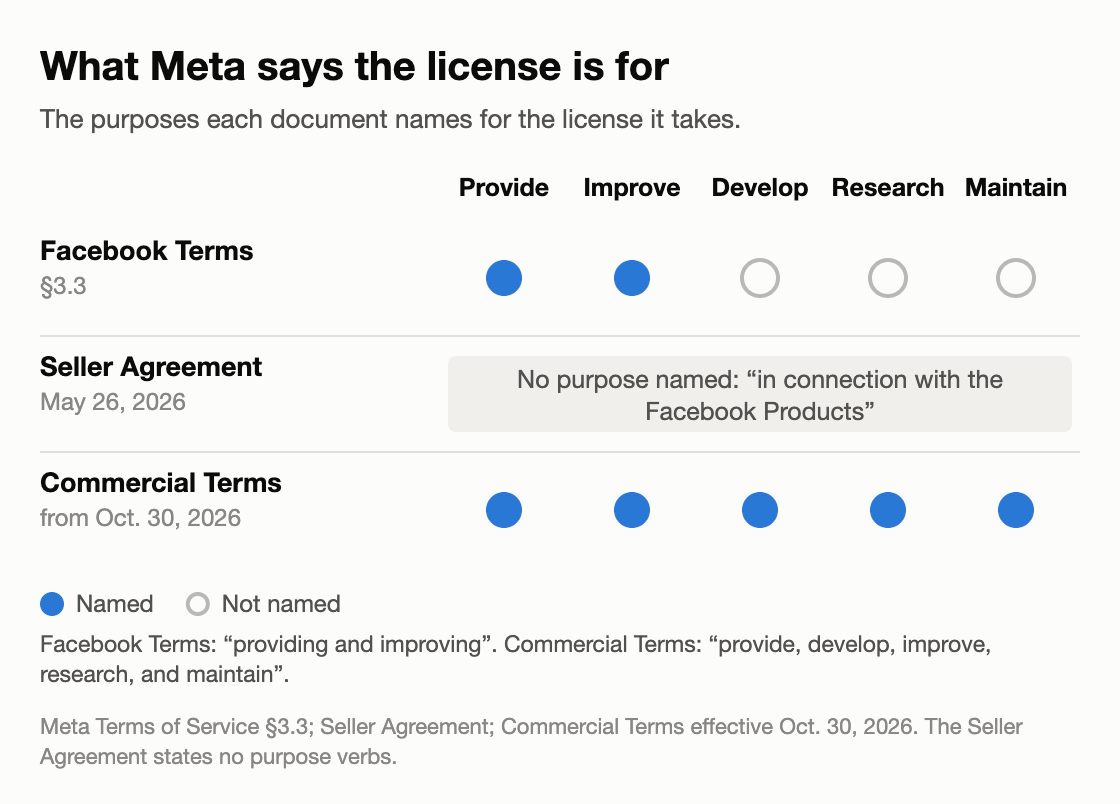
The license language grows. The current Commercial Terms send the reader back to the Terms of Service for what Meta may do with your content. The update adds that Meta may use it "to provide, develop, improve, research, and maintain" its products. It also authorizes Meta to run crawlers over the domains, pages and URLs associated with your products or services, and the content available through them, and to pull updates from them. The text does not say which uses "develop" and "research" cover.
Both versions say that continuing to use Meta's products for business after an update means you accept it.
Listing within it
What follows is a reading of the text, not legal advice.
Start with ownership. Sort what you plan to upload by who holds the rights: art and photographs you made, photographs a supplier provided, photographs customers sent, and anything showing another company's name or logo. Only the first group is yours to license without asking. A supplier's photograph stays the supplier's unless its terms let you pass it on, and Meta's Commerce Policies bar content that infringes a third party's intellectual property.
Upload less than you own. A mockup at web size licenses a picture of the product. A print-ready art file licenses the art. Meta needs the first.
Treat the page behind each product link as part of the submission. Open it as a stranger would and read everything on it: the copy, the images, the credits. Whatever on it is not yours is something you have now warranted.
Keep the records, since the warranty is yours: the file's creation date, a supplier's written permission, a model release, the receipt for a font or a stock license. The Seller Agreement also requires you to remove a listing promptly after a claim that it infringes someone's intellectual property, so know where that proof is before the claim arrives.
Finally, decide what to list on the assumption that it cannot be recalled. Art you may someday sell exclusively, or license to a brand, is better kept off the platform than licensed to it.
List the mockup, keep the master.
Originally published at the original source.